

What is Screw Conveyor
Screw conveyors, or auger conveyors, are industrial equipment used in transporting bulk quantities of granular solids (e.g., powder, grains, granules), semi-solids, liquids, and even non-flowing materials from one point to another. They uphold high operational efficiency by eliminating the need for the workers to manually move around loads. Screw conveyors primarily consist of a rotating screw shaft that is installed within a trough. As the screw shaft rotates, the material moves linearly. They can be designed to provide horizontal, vertical, and inclined travel paths.
Benefits of Screw Conveyor
High efficiency
With a simple design structure and effective operating principle, the screw conveyor allows the conveying and handling of materials quickly and efficiently.
High reliability
Sludge conveyors are usually made from high-quality materials such as sheet steel and stainless steel, ensuring durability and rigidity during use.
Cost savings
Using a screw conveyor can help save production and operating costs. With efficient material handling and distribution, it reduces labor time and effort, as well as saves materials and energy.
Flexibility
Can be customized and tailored to suit the specific requirements of each application. This makes it suitable for many different industries and sizes.


Why Choose Us
Advanced equipment
We take great measures to ensure that we work with the industry' s highest quality equipment and that our equipment is regularly and meticulously maintained.
Professional team
We have a team of skilled and experienced professionals who are well-versed in the latest technology and industry standards. Our team is dedicated to ensuring that our customers get the best service and support possible.
Competitive prices
We offer our products at competitive prices, making them affordable for our customers. We believe that high-quality products should not come at a premium, and we strive to make our products accessible to all.
Rich experience
Has a long-standing reputation in the industry, which makes it stand out from its competitors. With over many years of experience, they have developed the skills necessary to meet their clients' needs.
Efficient and convenient
The company has established marketing networks around the world to provide high-quality services to customers in an efficient and convenient manner.
Quality assurance
In terms of quality assurance, the company strictly follows the standards and norms of the industry quality system. Adopt industry-leading testing equipment to ensure product quality and good reputation.
Screw Conveyor (Vertical)
The screw body of the vertical screw conveyor rotates at a faster rate than the standard screw conveyor. There is friction between the conveying material and the casing due to centrifugal force, which stops the material from rotating with the screw blade and overcomes the materials' falling gravity. As a result, vertical material transportation is possible.
Screw Conveyor Horizontal
Due to the gravity of the material and friction between the machine slot and the machine slot, the material accumulated in the lower part of the machine slot does not rotate with the spiral body, but only moves forward driven by the rotating spiral blade when the material is added to the fixed machine slot. The horizontal screw conveyor is ideal for multi-point loading and unloading, and mixing, stirring, and cooling may all be done at the same time as the product is being conveyed.
Screw Conveyor with No Shaft
The shiftless screw conveyor, in contrast to the typical shaft screw conveyor, has no center shaft, which effectively prevents clogging and winding, and is suitable for conveying ribbon, loose, sticky, and easy-to-wind materials. The entire conveying process takes place in a closed conveyer, ensuring that the material does not flow out and that secondary pollution is avoided. The shiftless screw conveyor can be moved horizontally or at a 25-degree angle.
Screw Conveyor with an Incline
Inclined screw conveyors are a non-technical fixed kind that is also known as mobile screw conveyors. They have a tilt angle of less than 90 degrees and are available in a variety of sizes.
Screw Conveyor with Bending Ability
Because the bendable screw conveyor's screw shaft is flexible, the conveying line can be adjusted according to the space curve as needed. This screw conveyor can be used for both straight-line and bending conveying, and its high degree of flexibility makes it very easy for users to arrange various pieces of equipment. A single flexible screw conveyor with a vertical height of up to 10 meters and a horizontal distance of up to 25 meters can move materials. If necessary, numerous conveyors can be linked in series to transfer goods over longer distances.

Driving device, end bearing seat, screw shaft, screw blade, end feeding port, middle feeding port, intermediate bearing seat, head bearing seat, middle discharge port, head discharge port, machine slot, and so on are the basic components of the screw conveyor. When a screw conveyor is in use, the screw shaft rotates and the material goes forward down the conveyor's trough bottom under the blade's push. The material does not rotate with the screw conveyor blade due to the gravity of the material and friction between the material and the groove wall. Taxiing is a term used to describe the movement of materials through a conveyor.
So What Are the Limitations of Screw Conveyors
Large capacities
At some point, about 30,000 CFH or less, the screw conveyor is just not practical and another technology is preferable.
Long distances
In many applications a screw conveyor can convey up to hundreds of feet before it becomes impractical, but for some applications like food grade, inclines, or abrasive materials the distance can be around 20ft.
Fragile materials
The inherent tumbling of the conveyed material a screw conveyor causes and the pinching of the material between the screw and the trough make conveying fragile material impracticable.
Sticky materials
A screw conveyor has a lot of sharp corners and flat surfaces for sticky material to get hung up on.
Sanitary and food grad applications
Until the flow rates get to be above about 500 CFH, the screw conveyor is not ideal for sanitary applications due to the cost to polish all the steel on the screw.
Screw Conveyors and Materials Characteristics
Flowability:Materials that flow very easily won' t require as much power to move, and will move faster. Materials that are more dense and sluggish will require more power, and will move slower.
Corrosive:Corrosive materials will eat away at the screw, shaft and enclosure if they are not made from a resistant construction. Certain stainless steel grades or nickel alloys are ideal when working with corrosive materials.
Abrasive:Abrasive materials will wear away at the screw, shaft and enclosure through friction. Abrasion resistant alloys will help to reinforce screw conveyors with these materials.
Angle of Repose:The angle of repose will affect the material' s flow at varying inclines. If the screw conveyor is transporting materials across a vertical and horizontal distance, this will be particularly important.
Special Characteristics:Many special characteristics can affect the screw conveyor' s operation and design, such as levels of moisture or oil, clumping, toxicity, stickiness, dustiness, flammability, explosiveness and more.
How to Choose a Screw Conveyor
The conveying capacity of the screw conveyor refers to the amount of material conveyed per unit time. When transporting bulk materials, it is calculated as the mass or volume of material transported per hour; when transporting a piece of goods, it is calculated as the number of pieces delivered per hour. The conveying capacity of the screw conveyor is affected by many aspects. What are the factors that affect the conveying capacity of the screw conveyor? There is a detailed explanation in the article, the user can refer to it. Therefore, before the purchase, it is necessary to have a general understanding of the conveying capacity of the screw conveyor, so as to rationally design the model of the conveyor.
The conveying speed of the screw conveyor can be converted into conveying capacity, and the faster the speed of the screw conveyor, the better the conveying effect. However, the conveying speed of the screw conveyor should be combined with the design of the equipment itself.
If the conveying speed of the screw conveyor is too slow, the conveying amount is reduced and the conveying requirement is not reached. However, the conveying speed is too fast, exceeding the speed standard of the equipment itself. The material will be thrown outward due to excessive centrifugal force during the conveying process, so that the conveying cannot be carried out, the conveying efficiency is reduced, the energy consumption is large, and the wear of the equipment is accelerated.
The screw conveyor can be designed to be vertical, horizontal and inclined according to the requirements of the user. The conveying inclination directly affects the total resistance of the conveyor and the required power. The conveying capacity of the screw conveyor is the inclination of the conveyor. Increase and gradually decrease, so these conditions of use should be stated in the selection.
Under normal circumstances, when conveying powdery, granular or small block materials horizontally or obliquely, you can use ordinary screw conveyor (such as shaftless screw conveyor, etc.), and when conveying powdery and fine granular materials vertically. A vertical screw conveyor can be used.
There are various models of screw conveyors, and the conveying distances of different types of equipment are different, such as: horizontal screw conveyor conveying distance: ≤ 40 meters, vertical screw conveyor conveying distance: ≤ 20 meters. The conveying distance is also related to the selection of the screw conveyor motor. If the conveying distance is too large, it is necessary to increase the motor power and install a reducer.
The component dimensions of the conveyor include the pipe diameter (tube screw conveyor) or the width and depth of the tank, the size of the feed hopper, and the like. These component sizes directly affect the conveying capacity of the screw conveyor. Also consider the space of the user's site and the problem of placement, and choose the appropriate device size according to the size of the user's site.
How Do You Keep Your Screw Conveyor in Good Shape

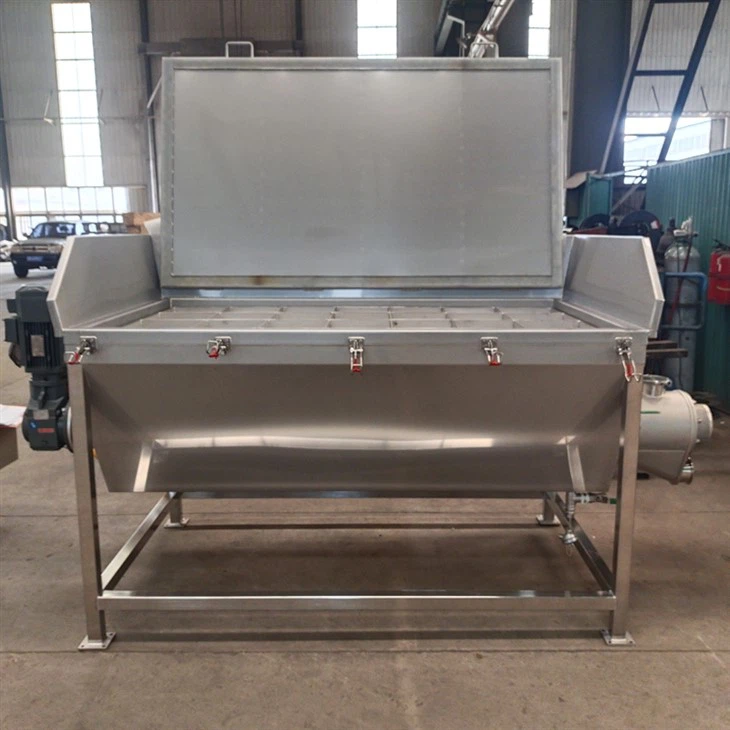


Keep the belt of your screw conveyor clean
While this sounds extremely complicated, a clean conveyor belt is often an optimal-performing belt.
A dirty belt is likely to slip, impacting the conveyor’s weight-carrying capacity. Next, any foreign build-up on the conveyor component parts such as the belt rollers can reduce the lifespan of both the belt and the motor.
You can consider investing in a conveyor that is equipped with easy-to-clean components, such as belt scrapers and belt lifters. These are designed to be regularly cleaned without major downtime and resources needed.
Keep the very important motor clean
Often, a conveyor belt motor that is covered with dust, dirt, grease, or food by-product will have its ventilation ports clogged, leading to overheating. When a motor overheats, it will need to be replaced - which makes it one of the costliest expenditures for your conveyor system. Ensure that your sanitation protocol is effective and strictly followed to avoid this.
Be on constant check for belt slippage
Improper belt tensioning or even loading your conveyor excess weight is the main culprit of belt slippage, as well as reducing the lifespan of your conveyor parts. Hence, regular inspections and tightening will help eliminate these issues.
Always perform inspections to replace worn parts
Did you know that worn parts are one of the major causes of screw conveyors malfunctioning? This is one of the main causes of breakdowns and extended downtimes, such as the need to wait for replacement parts to arrive.
That's why regular inspections of the whole screw conveyor belt system for worn and potentially damaged parts for timely replacements can significantly reduce the chances of conveyor downtime.
It is also a worthwhile conversion to have with the conveyor's manufacturer to learn the parts that are likely to wear out and to keep replacement parts ready for it.
Always implement preventative work and maintenance
Here's an insider tip from those who know screw conveyors best: preventive maintenance will save your conveyor from breakdowns and malfunctions.
It is therefore highly recommended to follow the manufacturer’s instructions for scheduling preventative maintenance. This includes inspecting most of the components, replacing parts that show wear and tear as well as upgrading the minor wiring and cables to higher-quality materials.
These tasks will help extend the life of your belt conveyor and avoid costly breakdowns.
Always check your pulley alignment for wear
Lastly, the pulley alignment of your screw conveyor plays the key role of keeping your belt conveyor running correctly. That's because an aligned pulley creates the equal belt tensioning on either side of the belt’s cross-section that is necessary to extend the life of your belt.
Screw conveyors are one of the oldest and simplest methods for moving bulk materials and consist primarily of a conveyor screw rotating in a stationary trough. Material placed in the trough is moved along its length by rotation of the screw which is supported by hanger bearings. Inlets, outlets, gates, and other accessories control the material and its disposition.
Screw conveyors are compact, easily adapted to congested locations, and can be mounted horizontal, vertical, and in inclined configurations. Their supports are simple and easily installed.
These versatile conveyors can be used to control the flow of material in preprocessing operations which depend upon accurate batching, or as a mixer, agitator, or stirrer to mix and blend dry or fluid ingredients, provide crystallization or coagulant action, or maintain solutions in suspension.
Screw conveyors can be effectively sealed to prevent dust or fumes from escaping or dirt or moisture from entering. They can be jacketed to serve as a dryer or cooler or furnished in a wide variety of materials to resist corrosion, abrasion, or heat.
Screw conveyors are used as earth augers to dig post holes or to bore under highways for installation of culverts. They are also used extensively on combines, threshing machines, hay bailers, fodder blowers, and many other farm machines.
Screw feeders are modified screw conveyors used to control the flow of material at a constant or variable rate from track hoppers, storage hoppers, bins, or tanks. They are suitable for handling a wide variety of materials ranging from fines to a combination of fines and lumps. Under many conditions, feeders are also used as a valve.
Screw feeders are totally enclosed, compact, simple in design, and dust tight. They are economical to install, operate, and maintain.
What You Need to Know About Sizing a Screw Conveyor
Understanding the material being conveyed is critical as this will determine the choice of screw diameter, pitch and speed. Conveyor design is also affected by factors such as packing density, particle size, moisture content and flowability.
Capacity is usually expressed in cubic feet per hour (ft3/h) or cubic meters per hour (m3/h). Determining the required capacity is critical to selecting the correct screw conveyor diameter to use and depends on the weight of the product and the required production rate.
The determination of the screw diameter depends on many factors, such as the rate of conveying the material, the filling level of the trough, the density of the material and the speed of the screw. The screw diameter determines the conveying capacity and is usually selected based on standardized dimensions. Common diameters range from 6 to 24 inches (15 cm to 61 cm). Pitch refers to the distance between consecutive threads on the screw. It affects the volume of material moved per revolution.
Calculating the power required to drive a conveyor takes into account the characteristics of the material, conveyor length, inclination angle and other factors. Power requirements determine the selection of appropriate motors and drive systems.
Our factory is located in the beautiful coastal city-Dalian, the geographical position is superior, the transportation is convenient, It can provide processing according to the customer' s drawing, accept customers' materials for processing, or design and product the goods all according to the customer' s requirement. The company has more than 50 sets of advanced mechanical equipment. With rich experience in stainless steel processing and production and the ability to undertake large-scale projects and orders, and have a strong product design capacity and market base. Products are constantly innovative and diversified.


Certifications
We always feel that all success of our company is directly related to the quality of the products we offer. They meet the highest quality requirements as stipulated in ISO 9001:2008,CE, Utility Model Patent Certificate, Supplier Assessment Certificate, Appreciation Award, UN Certificate(UN31A/Y).


FAQ
We're professional screw conveyor manufacturers and suppliers in China, specialized in providing customized stainless steel tanks made in China with competitive price. Please feel free to buy or wholesale bulk good quality screw conveyor for sale here and get quotation from our factory. For OEM and ODM service, contact us.
screw conveyor costing guide, screw conveyor pricing guide, screw conveyor selling guide